 Image 1 of 1
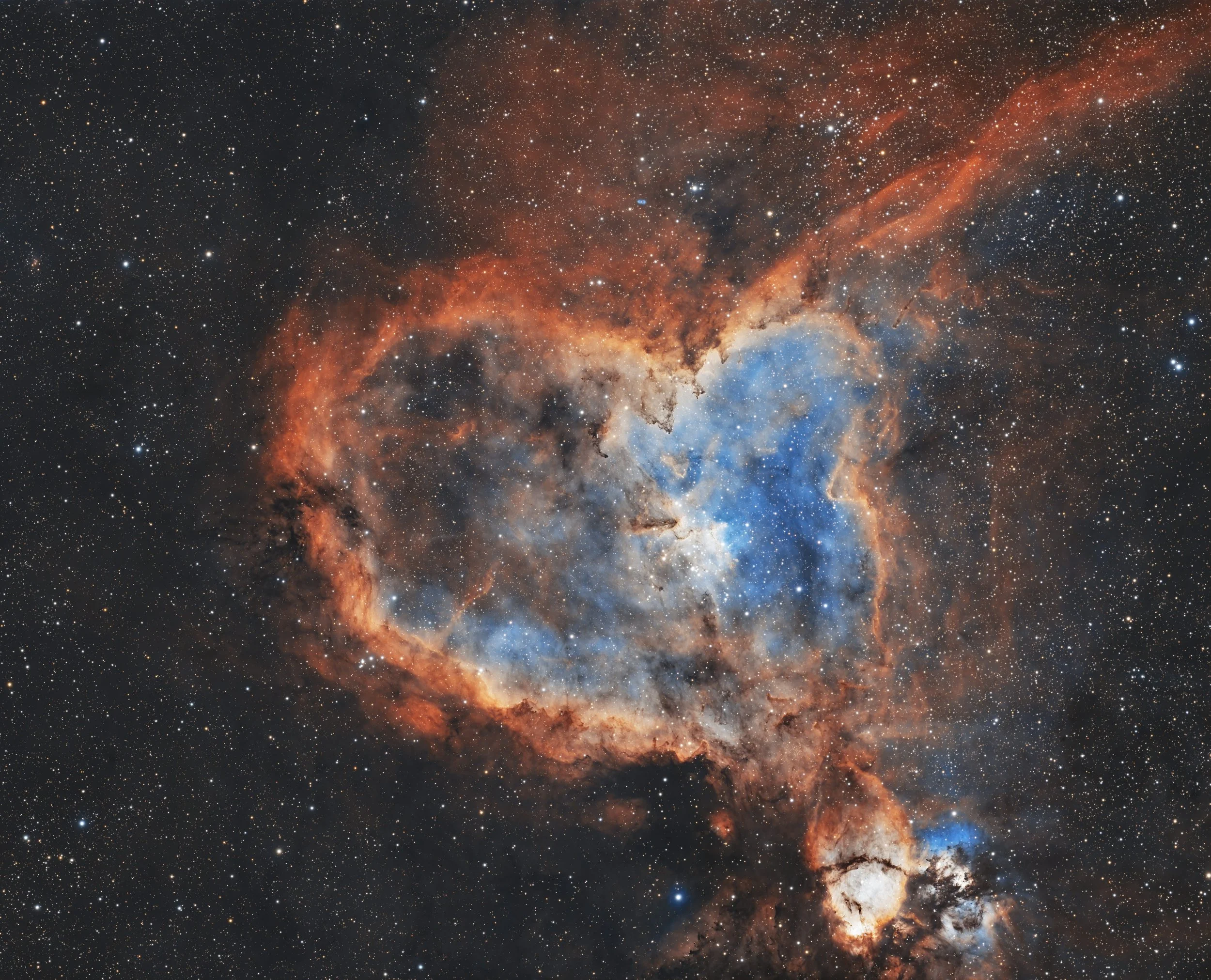
IC 1805 - The Heart Nebula
Captured over 40 hours, revealing faint, turbulent structures deep within the Heart Nebula.
Distance From Earth - 7.500 Light Years
Diameter - 200 Light Years
Total Exposure Time - 40 Hours 22 Mins
I started working on this image August 18 and October 8, 2026 with the intention of hanging it in the nursery when my daughter is born. It took more than 40 hours of exposure across nine nights, in two panels stitched together. The first nights were from our backyard in Flourtown. The rest were from a dark site JEC Observatories (Thanks @jecahill1971!), where the faint outer edges finally came through.
The Heart is a star-forming region: a cloud of gas, mostly hydrogen, where new stars are still being born. At its center is Melotte 15, a cluster only about 1.5 million years old. Some of its stars are about 50 times the mass of our Sun. Their radiation strips electrons from the surrounding gas, and the gas glows giving off the light I've captured. Their winds have hollowed out the cavity at the center. The colors here are a map, not what your eye would see. Warm gold shows hydrogen and cool blue shows oxygen, the way scientists separate different elements in Hubble images. The bright knot at the edge is the Fishhead Nebula, a denser pocket of the same cloud.
Printed to order and shipped directly to you. Typical delivery is 7–14 days.