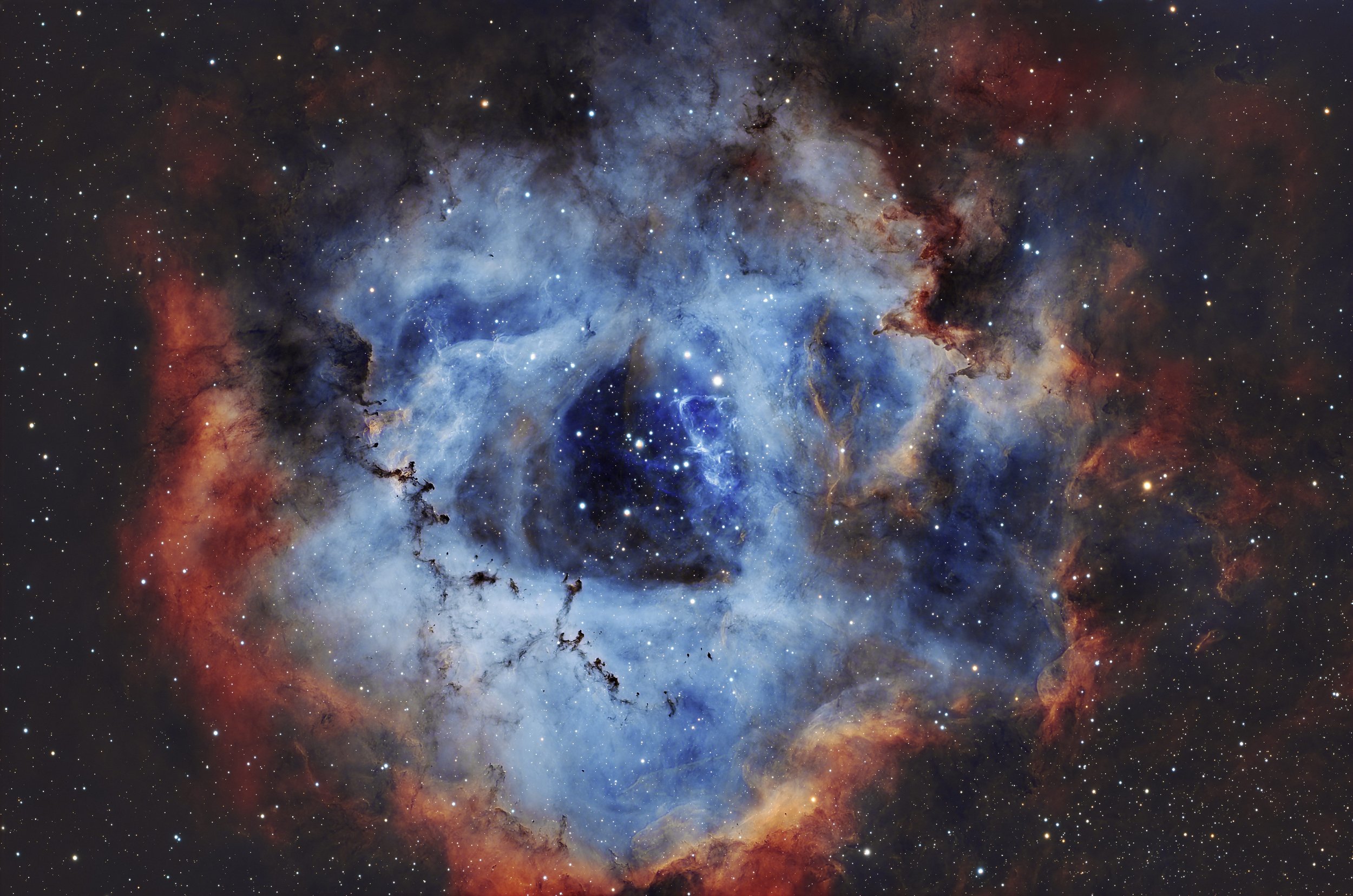
SH2-275 - The Rosette Nebula
Captured over 20 hours, revealing faint, turbulent structures deep within the Rosette Nebula.
Distance From Earth - 5,000 Light Years
Diameter - 130 Light Years
Total Exposure Time - 20 Hours
The Rosette Nebula is a large circular H II emission region located in the constellation Monoceros. At its center lies NGC 2244, an open cluster of young, hot O-type and B-type stars whose intense ultraviolet radiation has ionized and sculpted the surrounding molecular cloud, carving out a roughly 50 light year cavity at the nebula's core. This stellar wind pressure drives ongoing star formation in the denser outer shell, where embedded protostars and Bok globules are actively collapsing under gravity. Electron temperatures in the ionized zones are estimated between 7,000 and 9,000 K, with a total nebular mass on the order of 10,000 solar masses.
Printed to order and shipped directly to you. Typical delivery is 7–14 days.
Size Guide:
8×12" — Fits a standard frame. Great for a desk, shelf, or smaller wall space.
12×18" — A strong statement for a bedroom, office, or hallway.
24×36" — Gallery scale. Built to be the focal point of a room. Approximately the size of a standard movie poster.
Paper & Finish:
Glossy — Rich, vivid color with a reflective surface. Best in rooms with controlled lighting.
Matte — Soft, gallery-style finish that eliminates glare. Works beautifully in bright rooms or under direct light.
SH2 - 274 - The Rosette Nebulia
Captured over 20 hours, revealing faint, turbulent structures deep within the Rosette Nebula.
Distance From Earth - 5,000 Light Years
Diameter - 130 Light Years
Total Exposure Time - 20 Hours
The Rosette Nebula is a large circular H II emission region located in the constellation Monoceros. At its center lies NGC 2244, an open cluster of young, hot O-type and B-type stars whose intense ultraviolet radiation has ionized and sculpted the surrounding molecular cloud, carving out a roughly 50 light year cavity at the nebula's core. This stellar wind pressure drives ongoing star formation in the denser outer shell, where embedded protostars and Bok globules are actively collapsing under gravity. Electron temperatures in the ionized zones are estimated between 7,000 and 9,000 K, with a total nebular mass on the order of 10,000 solar masses.
Printed to order and shipped directly to you. Typical delivery is 7–14 days.