
IC 1848 - The Soul Nebula
Distance From Earth - 6,500-7,500 Light Years
Diameter - 100-150 Light Years
Total Exposure Time: 23.3 Hours
My last image of 2025 and possibly my favorite of the year. I was able to pull out tons of really interesting detail in the darker structures.
The Soul Nebula is a massive star-forming H II region located in the constellation Cassiopeia. It contains young, massive stars whose intense ultraviolet radiation ionizes the surrounding hydrogen gas, producing strong H-alpha emission that causes the nebula to glow red. In addition to hydrogen emission, the nebula contains emission from ionized sulfur ([S II]) and doubly ionized oxygen ([O III]). Typical electron temperatures in the ionized regions are estimated to be in 8,000–10,000 K range.
Size Guide:
8×12" — Fits a standard frame. Great for a desk, shelf, or smaller wall space.
12×18" — A strong statement for a bedroom, office, or hallway.
24×36" — Gallery scale. Built to be the focal point of a room. Approximately the size of a standard movie poster.
Paper & Finish:
Aluminum Dibond — A rigid metal panel with a completely glare-free surface that makes it at home in any lighting. No frame required — the print mounts flush to the wall on a hidden float mount, giving the image a clean, gallery-ready presence from edge to edge.
Glossy — Rich, vivid color with a reflective surface. Best in rooms with controlled lighting.
Matte — Soft, gallery-style finish that eliminates glare. Works beautifully in bright rooms or under direct light.
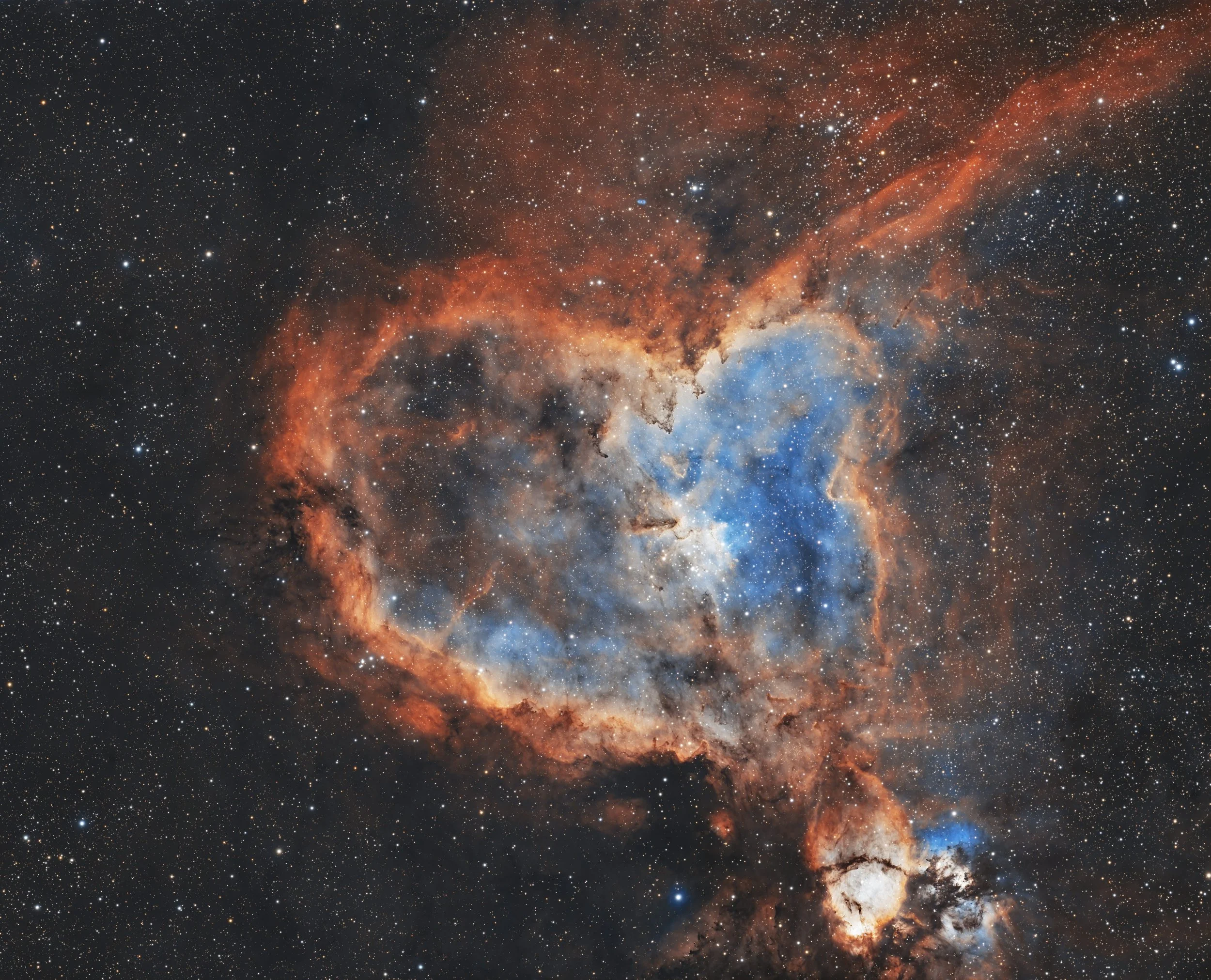
IC 1805 - The Heart Nebula
Captured over 40 hours, revealing faint, turbulent structures deep within the Heart Nebula.
Distance From Earth - 7,500 Light Years
Diameter - 200 Light Years
Total Exposure Time - 40 Hours, 22 Mins
The Heart is a star-forming region: a cloud of gas, mostly hydrogen, where new stars are still being born. At its center is Melotte 15, a cluster only about 1.5 million years old. Some of its stars are about 50 times the mass of our Sun. Their radiation strips electrons from the surrounding gas, and the gas glows giving off the light I've captured. Their winds have hollowed out the cavity at the center. The colors here are a map, not what your eye would see. Warm gold shows hydrogen and cool blue shows oxygen, the way scientists separate different elements in Hubble images. The bright knot at the edge is the Fishhead Nebula, a denser pocket of the same cloud.
I started working on this image August 18 with the intention of hanging it in the nursery when my daughter is born. It took more than 40 hours of exposure across nine nights, in two panels stitched together.
Printed to order and shipped directly to you. Typical delivery is 7–14 days.