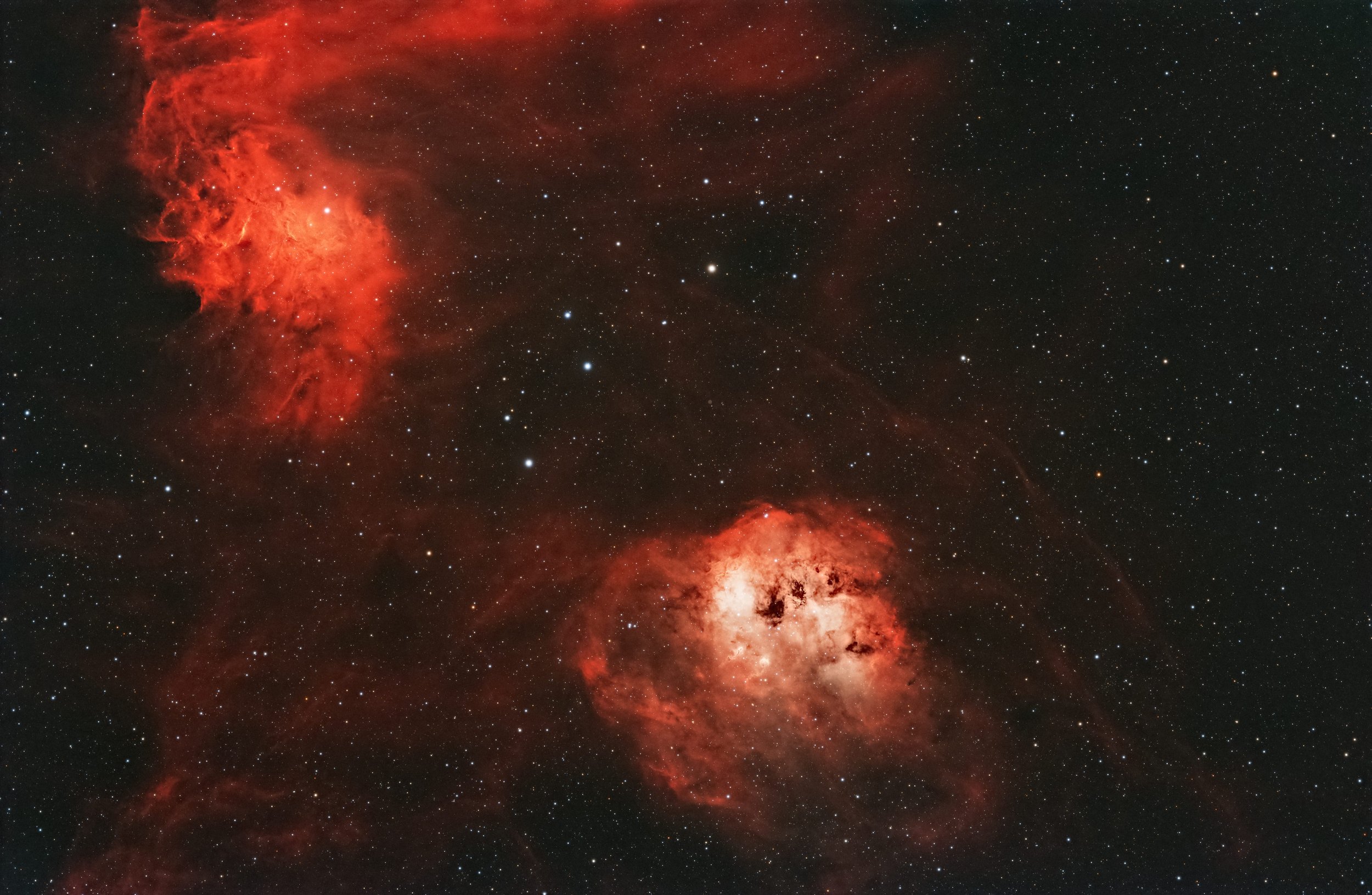
IC 405 and IC 410 - The Flaming Star and Tadpoles Nebulas
Total Integration Time: 17 Hours
IC 405 - Flaming Star Nebula (Top left) - Emission and Reflection Nebula located about 1,500 light years from Earth and 5 light years in diameter.
IC 410 - Tadpole Nebula (Bottom right) - Emission Nebula 12,400 light years from Earth and about 100 light years in diameter.
Size Guide:
8×12" — Fits a standard frame. Great for a desk, shelf, or smaller wall space.
12×18" — A strong statement for a bedroom, office, or hallway.
24×36" — Gallery scale. Built to be the focal point of a room. Approximately the size of a standard movie poster.
Paper & Finish:
Aluminum Dibond — A rigid metal panel with a completely glare-free surface that makes it at home in any lighting. No frame required — the print mounts flush to the wall on a hidden float mount, giving the image a clean, gallery-ready presence from edge to edge.
Glossy — Rich, vivid color with a reflective surface. Best in rooms with controlled lighting.
Matte — Soft, gallery-style finish that eliminates glare. Works beautifully in bright rooms or under direct light.
IC 405 & IC 410 - Flaming Star and Tadpoles Nebulas
Captured over 17 hours, revealing faint, turbulent structures deep within these two nebulas as well as surrounding Ha gas.
Flaming Star (top left)
Distance From Earth - 1,500 Light Years
Diameter - 5 Light Years
Total Exposure Time - 17 Hours
Tadpoles (bottom right)
Distance From Earth - 12,000 - 12,400 Light Years
Diameter - 100 Light Years
Total Exposure Time - 17 Hours
IC 405, the Flaming Star nebula is an emission and reflection nebula located in the constellation Auriga. It glows due to it being energized by the hot, fast moving star AE Aurigae, whose intense ultraviolet radiation excites the surrounding hydrogen gas causing it to emit a deep red light.
IC 410, the Tadpoles Nebula is an emission nebula also located in the constellation Auriga. Its most distinctive features are two elongated clouds of dense gas and dust - nicknamed the “tadpoles” - which are sculpted by intense radiation and stellar winds from nearby massive stars.
This image took 2nd place in a “What’s In the Night Sky” run by Alyn Wallace in February 2024.
Printed to order and shipped directly to you. Typical delivery is 7–14 days.