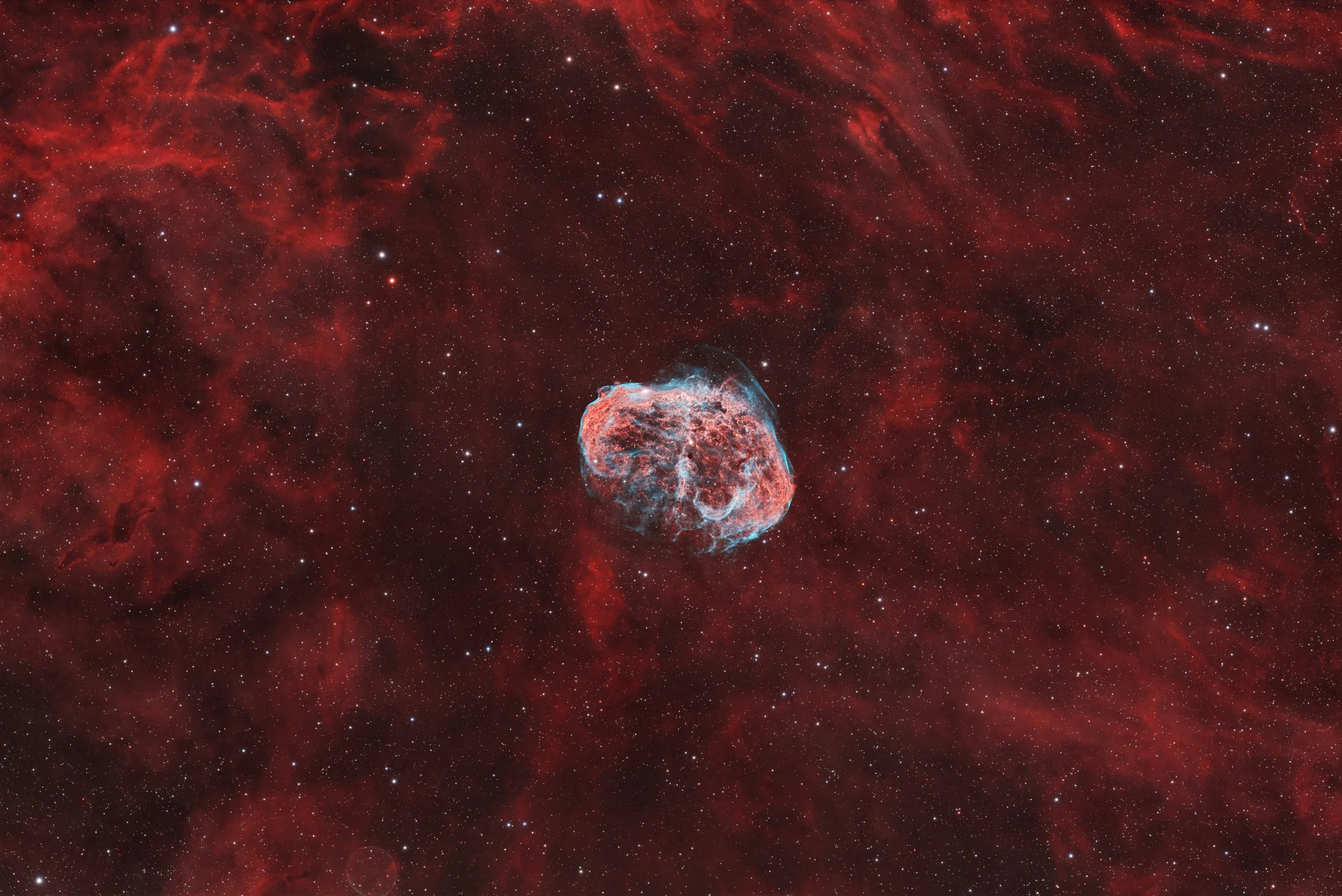
NGC 6888 – The Crescent Nebula
11.8 hours of integration, capturing the glowing shell of stellar wind surrounding one of the Milky Way's most energetic stars.
Distance From Earth — ~5,000 Light Years
diameter — 25 light years
Total Exposure Time — 11.8 Hours
The Crescent Nebula is a wind-blown bubble of ionized gas shaped by WR 136, a massive Wolf-Rayet star near the end of its life. The nebula formed as the star's powerful stellar wind collided with slower-moving material shed during an earlier red giant phase, compressing and sculpting it into the distinctive crescent shape visible here. The red H-alpha emission traces the hydrogen shell, while the cyan [OIII] glow along the inner edge marks the hotter, more energetic region closest to the star. The broader red nebulosity filling the frame is the Sadr Region — the same hydrogen-rich cloud that surrounds much of central Cygnus.